AlkaLean is a once-daily capsule built on three things: a prebiotic fibre, a resistant starch, and three probiotic strains. Together they target the gut environment rather than pushing your metabolism with stimulants.
There is no caffeine, no thermogenic, and no GLP-1 drug in it. What there is, is a published label — and this page shows all of it, including the parts the sales pages skip.
60-day money-back guarantee · No subscription · Official site only
Most weight-management supplements pick one of two routes: stimulants that raise your heart rate for ninety minutes, or botanical blends whose evidence is thinner than the label suggests. AlkaLean takes a third route — feeding the gut microbiome and letting the downstream signalling do the work.
That mechanism is legitimate and actively researched. Read the full overview, or go straight to the ingredient breakdown.
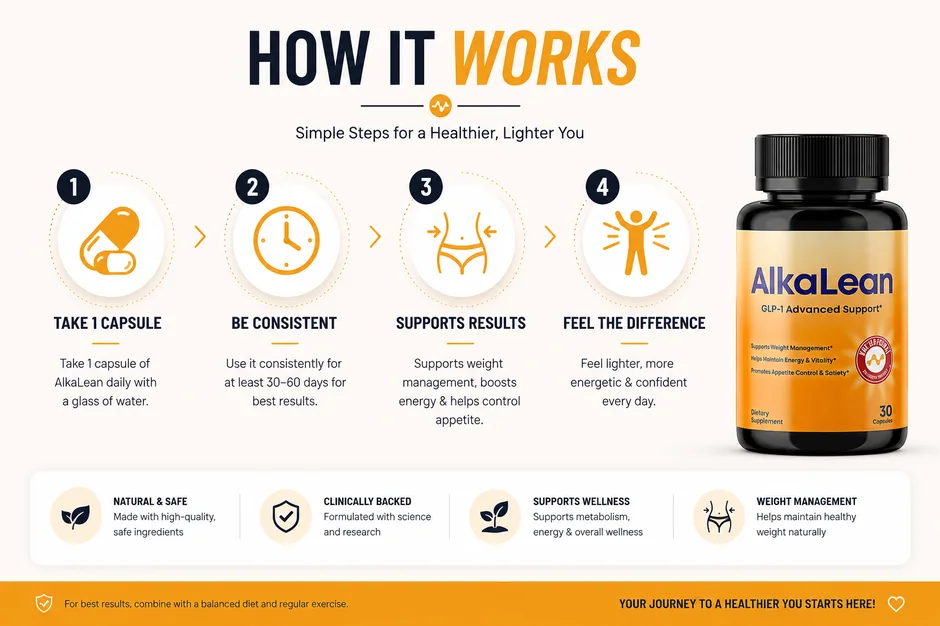
Four steps, described as a mechanism rather than a promised outcome.
Inulin and resistant starch aren't digested by human enzymes. They pass through the small intestine intact and arrive where your gut bacteria live.
Resident bacteria break the fibre down, producing short-chain fatty acids — butyrate in particular, a primary fuel for the cells lining your colon.
Those short-chain fatty acids are one of the signals that stimulate gut L-cells to release GLP-1, a hormone involved in satiety and glucose handling.
Akkermansia muciniphila, Clostridium butyricum and Bifidobacterium infantis are included to support the microbial community doing that fermenting.
This is the single most useful thing on the page, so it isn't buried at the bottom.
None of this makes AlkaLean a scam. It publishes a real ingredient list with real milligram amounts, which many competitors don't. It does mean the fibre content is better understood as a small daily contribution than as a research-level intervention — and expectations should follow that.
Two prebiotics with published amounts, three named probiotic strains, four standard excipients.
The primary prebiotic fibre. Inulin is a fructan that human enzymes can't break down, so it reaches the colon intact and feeds the bacteria already living there. Chicory root is the standard commercial source.
Read the full guide →A starch that resists digestion and ferments in the colon, producing butyrate. Genuinely well-researched as a mechanism — at gram-level doses, which this isn't. Honest detail in the guide.
Read the full guide →The most interesting strain here. It lives in the gut mucus layer and has attracted substantial research attention around metabolic health — though most of that work involves specific preparations and doses.
Read the full guide →A butyrate-producing strain, which fits the formula's mechanism directly — it makes the same short-chain fatty acid the prebiotic fibres are there to encourage.
See full details →One of the better-known Bifidobacterium species, with research mostly around digestive comfort and gut barrier function.
See full details →Hypromellose (a plant-based capsule shell), microcrystalline cellulose, magnesium stearate and silica — all standard, widely used manufacturing components.
See full details →Not for use by anyone under 18, or anyone pregnant or nursing.
Expect a settling period. Starting a prebiotic fibre commonly causes temporary bloating or wind in the first week or two — that's fermentation happening, which is the mechanism working rather than failing. It usually settles. If it doesn't after two or three weeks, or if it's genuinely uncomfortable rather than just noticeable, stop and speak to a doctor.
AlkaLean is not a treatment for obesity, diabetes or any medical condition. If your weight is affecting your health, that is a conversation worth having with a doctor rather than a decision to make from a supplement label.
Brand-published customer statements. See our reviews guide for what the independent record does and doesn't contain.

“I wanted something without stimulants. The first fortnight was a bit gassy, which the label warned about, and then it settled.”

“One capsule with breakfast. I've abandoned enough complicated routines to know that the simple ones are the ones I keep.”

“I emailed and asked for the CFU counts before ordering. Worth doing — ask before you buy, not after.”
The widely-quoted 4.98/5 rating is brand-reported. The review platform, methodology and verification process behind it were not independently verified. Treat it as marketing material rather than audited data.
Three package sizes, each bottle a 30-day supply. No subscription on any of them.
Sixty days from your purchase date, covering every package size. There's no subscription to cancel — which removes the most common billing complaint in this category before it can happen.
Full detail on our refund policy page.

Fibres and probiotic strains rather than synthetic stimulants.

Supplements are not FDA-approved; this describes the plant.

Produced under Good Manufacturing Practice controls.

With individual milligram amounts printed on the panel.
Structure/function statements for healthy adults — not promised medical results.
The most direct and best-supported claim. A prebiotic-plus-probiotic pairing is a coherent, well-understood approach to supporting gut flora.
Short-chain fatty acid production supports the colon lining. Note the settling period when starting — covered in the safety section.
The GLP-1 signalling pathway is real physiology. Whether this capsule moves it meaningfully at these amounts is the open question.
AlkaLean is not a weight-loss drug, not a GLP-1 medication, and not a treatment for any condition. Full detail on the benefits page.
Independent sources on the ingredients and the mechanism this formula targets.
These citations concern the individual ingredients and the general mechanism, not the finished AlkaLean product. Published studies typically use doses far above those on this label — see the dose section. No clinical trial on AlkaLean itself has been identified. These statements have not been evaluated by the FDA and are not intended to diagnose, treat, cure or prevent any disease.
60-day money-back guarantee · No subscription · Official site only
A once-daily capsule built around gut microbiome support. The label lists Chicory Root Inulin at 211 mg, Potato Resistant Starch at 100 mg, and a 35 mg probiotic blend of Akkermansia muciniphila, Clostridium butyricum and Bifidobacterium infantis.
No. It's a dietary supplement, not a medication. It contains no GLP-1 agonist, isn't comparable to prescription drugs like semaglutide, and isn't a substitute for prescribed treatment. Its proposed mechanism is prebiotic fibre fermentation supporting your body's own GLP-1 signalling — a different thing entirely.
That's the formula's main open question. Resistant starch research typically uses 15–30 grams daily against 100 mg here; inulin research generally uses gram-level doses against 211 mg. The ingredients are real and disclosed, but the amounts sit well below typical research levels. See the dose section.
No. The blend is listed as 35 mg total across three strains, but colony-forming units — the standard measure of probiotic potency — aren't disclosed. Contact the brand and request CFU per strain before ordering; it's standard due diligence for any probiotic purchase.
No clinical trial on AlkaLean as a finished product has been identified. The available research is ingredient-level work on chicory inulin, resistant starch and the individual strains — which doesn't establish safety or effectiveness for a finished formula.
Possibly, for the first week or two. Prebiotic fibre ferments in the colon and fermentation produces gas — that's the mechanism working, not failing. It usually settles. If it doesn't after two or three weeks, or if it's genuinely uncomfortable, stop and speak to a doctor.
Anyone under 18, anyone pregnant or nursing, and anyone immunocompromised without medical advice. Speak to a doctor first if you take diabetes or blood sugar medication, or if you have IBS or follow a low-FODMAP diet — inulin is a fermentable FODMAP.
No. Every package is a one-time purchase with no automatic renewal, which removes the most common billing complaint in this product category.
Ingredient deep-dives and honest assessments from our editorial team.
The most important distinction in this category right now, and why the marketing blurs it.
Read article → IngredientA genuinely well-researched ingredient at an amount nowhere near the research doses.
Read article → IngredientThe mucus-layer strain behind a decade of metabolic research interest — and its limits.
Read article → IngredientHow prebiotic fibre actually works, and why the first fortnight feels the way it does.
Read article → GuideMilligrams tell you almost nothing about a probiotic. Here's what to request instead.
Read article → ReviewWhat's realistic at each stage, and how to tell a real effect from a confounder.
Read article →